Affiliate Disclosure: Some links in this article are affiliate links. If you purchase through them, IronThaw earns a commission at no extra cost to you. Our rankings are independent — we do not accept payment for placement.

Every cold water immersion argument eventually reduces to the same question: do you actually need a $3,000 tub, or will a bathtub and a few bags of ice from the gas station do the exact same thing? The honest answer is that the water doesn't care where the cold came from. What differs between a cold plunge tub and an ice bath isn't the physiology — it's the cost, the convenience, and how likely you are to still be doing it in six months.

This guide breaks down the real differences so you can decide which setup fits your budget, your space, and how seriously you're taking cold exposure as a long-term habit rather than a New Year's resolution.

What's the Actual Difference?

An ice bath is the low-tech version: a standard bathtub (or a stock tank, or an inflatable tub) filled with cold tap water and brought down to target temperature using bagged or homemade ice. There's no refrigeration unit — the cold comes entirely from the ice melting, which means the water warms back up as soon as the ice is gone.

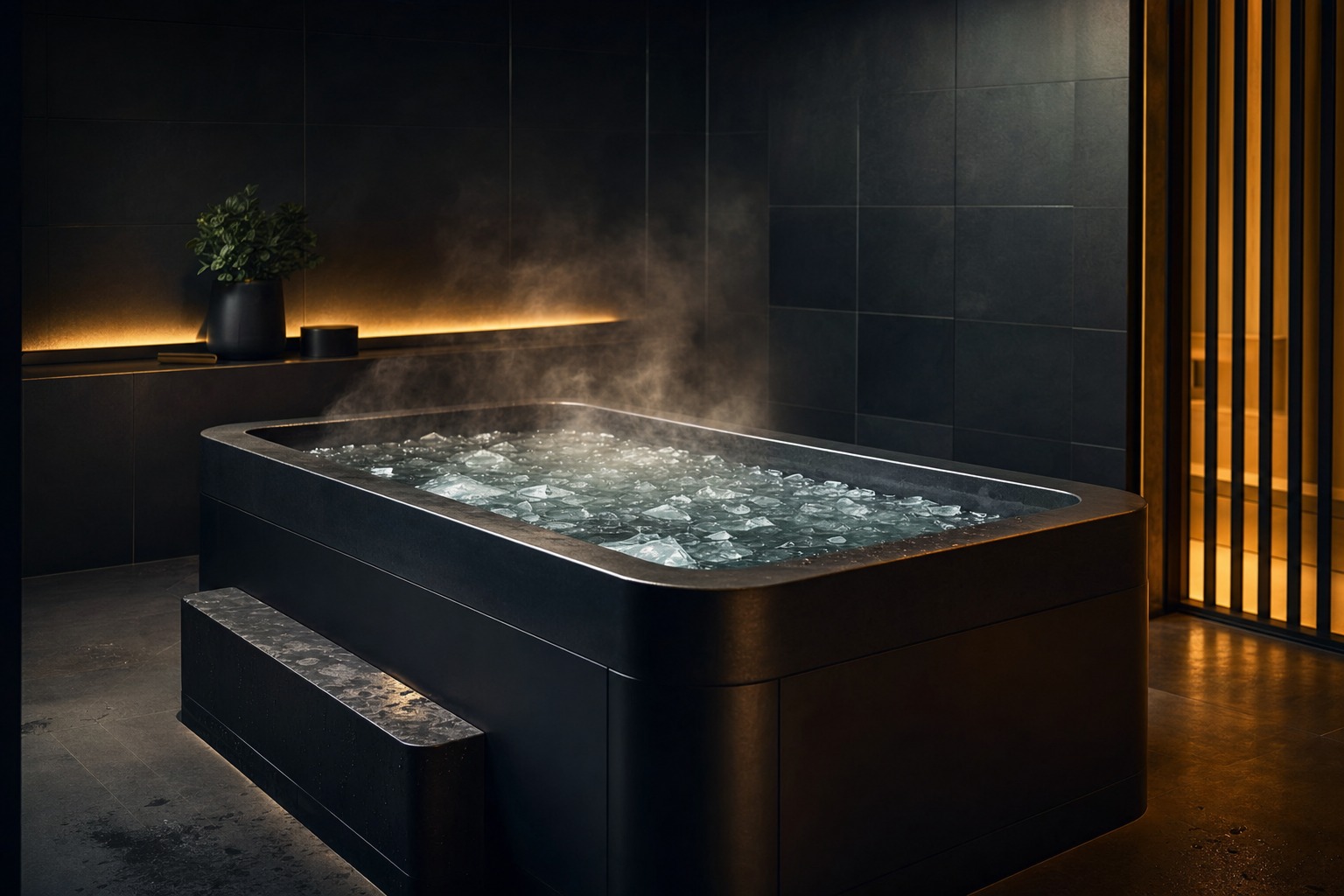
A cold plunge tub is a purpose-built vessel with an integrated chiller (a small refrigeration compressor, similar to what runs a mini-fridge or window AC unit) that actively cools and holds the water at a set temperature indefinitely. Most also include filtration — ozone or UV-C — so the same water can be reused for weeks without changing it, which an ice bath generally cannot do hygienically for long.

That's the entire structural difference. Everything else — the physiological response, the mental toughness component, the post-workout recovery benefit — is a function of water temperature and immersion time, not the mechanism that produced the cold.

Temperature: Consistency vs. Fluctuation

This is where the two approaches genuinely diverge in practice, even if the underlying science doesn't care.

A chiller-equipped cold plunge holds temperature within about ±1–2°F of your set point, session after session, regardless of room temperature or how long the water's been sitting. Set it to 45°F and it stays at 45°F whether you get in Monday morning or Friday night.

An ice bath is a decaying system. The moment you dump the ice in, you start a clock: the water is coldest a few minutes after mixing and steadily warms as the ice melts and ambient heat transfers in. In a typical bathroom, a well-iced tub might hold under 50°F for only 15–20 minutes before drifting upward. If you're inconsistent with how much ice you use, your "cold plunge" varies by 5–10°F from session to session — which matters if you're trying to follow a specific protocol (like Huberman's 11-minutes-per-week guidance) that assumes a defined temperature range.

Factor Ice Bath Cold Plunge Tub
Upfront cost $0 (uses existing bathtub) $500 – $8,000
Per-session cost $3 – $8 in ice ~$0.10 – $0.40 in electricity
Temperature stability Fluctuates, warms as ice melts Holds ±1–2°F consistently
Setup time per use 10–20 min (fill, buy/store ice) 0 min (always ready)
Water reuse / filtration Drain after each use Filtered, reusable for weeks
Portability Fully portable (any tub) Fixed or semi-portable, needs power
Best for Testing the habit, travel, tight budget Daily use, consistency, long-term commitment

Cost Comparison: The Real Numbers

An ice bath's upfront cost is effectively $0 if you already have a bathtub. Your only recurring expense is ice — typically $1.50–$2.50 per 7-lb bag at a grocery or gas station, and most people use 4–6 bags per session to bring a tub down to the 39–50°F range. That's roughly $6–$15 per session in ice alone, before accounting for the time spent buying and hauling it.

A dedicated cold plunge tub ranges from around $500 for a portable, unchilled inflatable (you still need ice for these — you're just paying for a dedicated vessel instead of your bathtub) up to $8,000+ for premium chiller-equipped units with filtration, ozone purification, and multi-year warranties. Most serious home setups — the kind people actually use daily for years — land in the $2,000–$5,000 range.

Best Overall Cold Plunge

Plunge Original+ — $2,990

Stainless steel basin, chiller down to 37°F, ±2°F hold accuracy, 3-year warranty. The category leader for a reason — no ice, no fluctuation, ready every single day.

Check Price on Plunge.com

Convenience: Ice Bags vs. Always-Ready Water

This is the factor most people underestimate before they start, and the one that ends up deciding whether cold exposure becomes a habit or a memory.

With an ice bath, every session requires a logistics chain: you need ice on hand (which means remembering to buy it, or owning an ice maker that produces enough volume), you need to fill and drain the tub, and you need to clean it between uses since bathtubs aren't designed for repeated cold-water dunking with skin contact. None of this is hard, but it's friction — and friction is the single biggest predictor of whether a wellness habit survives past week three.

A cold plunge tub removes essentially all of that friction. The water is at temperature 24/7. You walk up, get in, and get out. For people plunging 4–7 times a week, this difference compounds fast — it's the gap between "I'll do it later" and "it's right there."

Zero-Friction Option

RecoverEx Ice Bath Pro — ~$4,050

Despite the name, this is a fully chilled, insulated tub — not a manual ice bath. Strong filtration and insulation mean lower running costs and consistent daily-use temperatures.

View RecoverEx Ice Bath Pro

Does the Science Actually Distinguish Between Them?

Almost never — and this is the most important point in this entire article. Cold water immersion (CWI) research designs studies around water temperature and immersion duration, not the equipment used to produce the cold. A study protocol reads "10°C for 10 minutes," not "using a chiller-equipped tub." Whether that 10°C water was achieved by a compressor or by dumping in ice from a gas station is irrelevant to your nervous system, your norepinephrine response, or your inflammation markers.

The physiological cascade — a spike in norepinephrine (documented increases up to 300% in some protocols), reduced perceived muscle soreness, and short-term reductions in inflammatory markers like IL-6 — is a function of how cold the water is and how long you stay in it. A $6,000 tub at 50°F for three minutes produces the same immersion stimulus as a bathtub iced down to 50°F for three minutes. CWI is CWI.

Where a cold plunge tub earns its keep isn't in superior physiology — it's in superior adherence and precision. If a study (or your own protocol) calls for a specific temperature held for a specific duration, a chiller makes that trivially repeatable. An ice bath makes it approximate. For occasional use, approximate is fine. For a tracked, long-term protocol, precision starts to matter.

When an Ice Bath Makes Sense

Best Budget Entry Point

Cold Tub Portable — ~$499

An inflatable tub built for cold exposure (not a chiller unit) — still requires ice, but gives you a dedicated, durable vessel instead of using your bathroom tub. The logical step up from a literal bathtub before committing to a chiller.

View Cold Tub Portable

When a Cold Plunge Tub Is Worth It

The Real Breakeven Point: How Many Ice Bags Before a Tub Pays For Itself

Here's the math that actually matters when deciding whether to upgrade.

Assume an average ice bath session costs $8 in ice (a middle estimate for 4–6 bags at current prices). A budget cold plunge tub costs around $2,990 (Plunge Original+) with negligible per-session electricity cost (roughly $0.20/session, which we'll fold in as a rounding error).

\( \$2{,}990 \div \$8 \approx 374 \) sessions

At 5 sessions per week, that's 374 ÷ 5 ≈ 75 weeks — about 17 months — before the tub has paid for itself purely in avoided ice costs, before you even count the time saved or the improved consistency.

At daily use (7 sessions/week), breakeven drops to 374 ÷ 7 ≈ 53 weeks — right around one year.

For a cheaper tub, the math improves fast. A $500 portable (still requiring ice, so this doesn't apply directly) isn't a fair comparison — but a mid-range $2,000 chiller unit breaks even at 250 sessions, or about 36 weeks at 7 sessions/week — under 9 months.

The takeaway: if you're plunging fewer than 2–3 times per week, ice remains cheaper for a long time and the convenience gap is small. If you're plunging 5+ times per week and plan to keep doing it for over a year, a dedicated tub is very likely the cheaper option on a 2–3 year horizon — and that's before factoring in the time saved and the elimination of "I don't feel like buying ice today" as an excuse to skip a session.

The Hybrid Approach: Start Cheap, Upgrade Later

The lowest-risk path for most people is sequential, not either/or:

  1. Weeks 1–4: Use your bathtub and bagged ice. Confirm you'll actually do this 3+ times a week before spending anything.
  2. Months 2–3: If the habit sticks, move to a dedicated portable tub like the Cold Tub Portable (~$499) — still ice-based, but purpose-built, easier to clean, and doesn't tie up your bathroom.
  3. Month 4+: Once you have several months of consistent data on your own behavior, upgrade to a chiller-equipped tub (Plunge Original+ or RecoverEx Ice Bath Pro) if the breakeven math above favors it for your frequency.

This staged approach avoids the single biggest mistake in this category: buying an $3,000–$8,000 tub in week one on enthusiasm alone, then using it four times before it becomes a very expensive storage container.

FAQ

Is a cold plunge better than an ice bath?

Physiologically, no — the water doesn't know whether the cold came from a chiller or a bag of ice. A cold plunge tub is "better" in the sense that it delivers more consistent temperature, requires less ongoing effort, and holds up over years of daily use. An ice bath is equally effective per session and costs far less to start. The right answer depends on your budget and how many times per week you plan to get in.

How many ice bags equal a cold plunge session?

To chill a standard bathtub (about 40–50 gallons of water) from tap temperature down to the 39–50°F range typically takes 4 to 6 bags of ice (7 lb bags), depending on your starting water temperature and ambient room temperature. In colder climates or with pre-chilled tap water, 3 bags can be enough.

Does the research show a difference between cold plunge tubs and ice baths?

No. Nearly all cold water immersion (CWI) research measures water temperature and immersion time, not the equipment used to produce the cold. Studies on inflammation markers, norepinephrine response, and muscle soreness apply equally whether the water was chilled by a compressor or by melting ice, as long as the temperature and duration match.

How much does a cold plunge tub cost compared to an ice bath?

An ice bath using a household bathtub costs effectively $0 upfront, with an ongoing cost of roughly $3–$8 per session in ice. A dedicated cold plunge tub with a chiller ranges from about $500 for portable, unchilled models to $2,000–$8,000 for chiller-equipped units from brands like Plunge or RecoverEx, with no per-session ice cost.

The Bottom Line

Cold plunge vs. ice bath isn't a battle of effectiveness — it's a battle of logistics. The physiological benefits of cold water immersion are driven by temperature and duration, not the machine behind them, so an ice bath in your own tub is a completely legitimate way to start, especially while you're still validating that you'll stick with it. But if you're already plunging several times a week and plan to keep going, the math tips clearly toward a dedicated tub within about a year — and the Plunge Original+ remains the safest, most proven buy in that category, with RecoverEx as the strongest value alternative.

Subscribe for more

Get The Recovery Dispatch — Free

Weekly protocol notes, exclusive discount codes, and new guide alerts. 3,400+ subscribers.

Join the Newsletter