Affiliate Disclosure: IronThaw may earn a commission when future partner links are added. This informational safety guide contains no paid placement, product-testing claim, or medical advice.
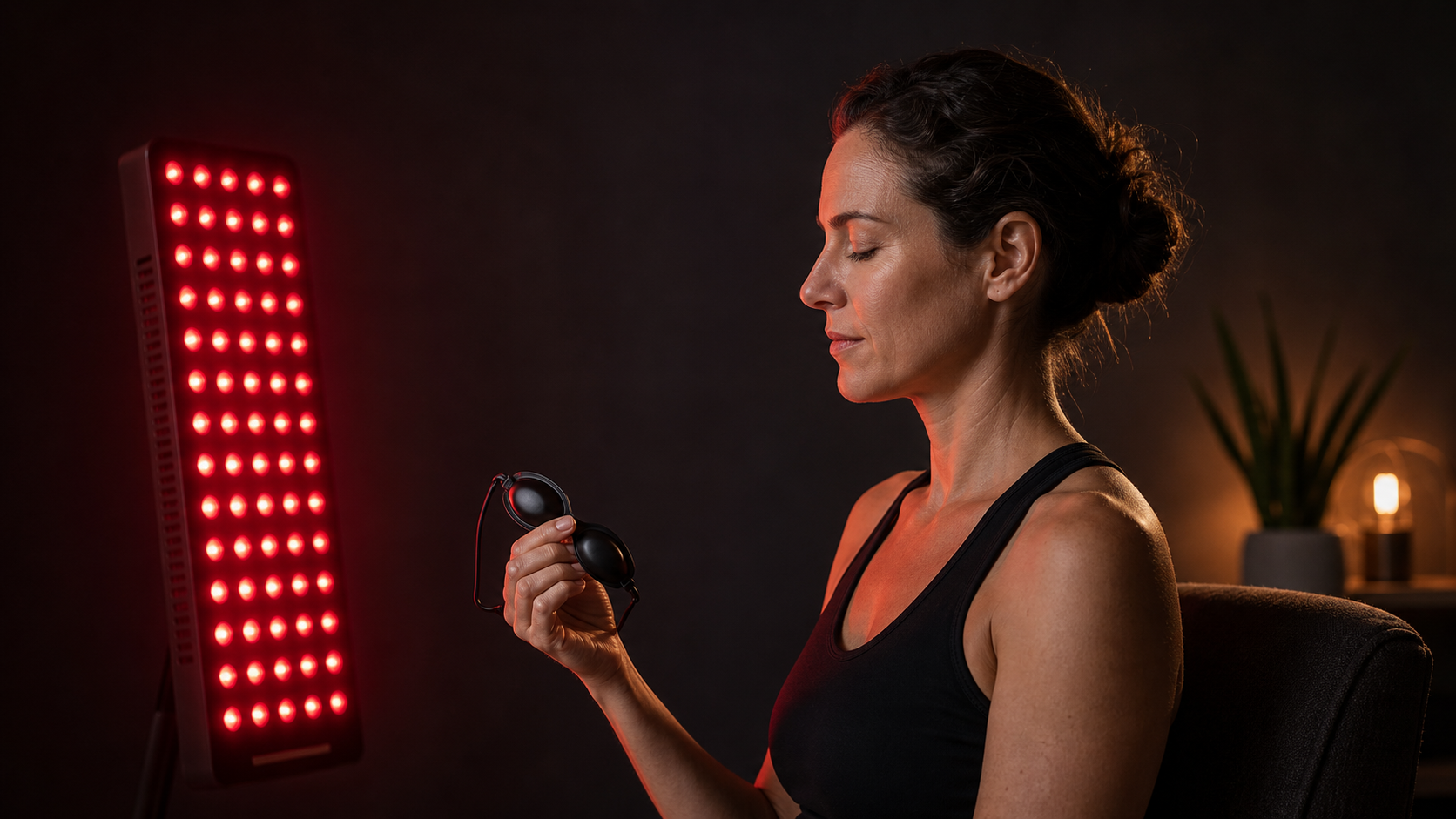
Short answer: Follow the eye-safety instructions for your exact red light device. Wear the supplied or manufacturer-specified goggles whenever the manual requires or recommends them—especially for a bright panel near your face. Do not stare into illuminated LEDs. Closing your eyes may reduce visible brightness, but it is not a universal replacement for eye protection.
A red light panel can make an entire room glow, so eye comfort is often the first practical concern for a beginner. The confusing part is that home devices differ in output, wavelengths, beam pattern, recommended distance, and intended use. That means there is no responsible one-line rule that overrides every product manual.
The useful beginner rule is simpler: treat the manufacturer’s instructions as the minimum standard, avoid deliberate direct viewing, and make the session comfortable enough that you are not squinting or improvising. Eye protection is one part of the setup—not permission to stand closer, stay longer, or ignore symptoms.
Eye protection by session setup
| Setup | Practical default | Do not assume |
|---|---|---|
| Panel facing the face | Use the supplied or specified goggles when required or recommended; keep eyes closed and avoid staring. | That closed eyelids alone satisfy every device’s guidance. |
| Body area below the neck | Angle or position yourself so you do not look into the LEDs; follow the manual’s eye guidance. | That distance and reflected room light never matter. |
| Small handheld device | Use only for body areas allowed by its instructions and keep it away from eyes unless specifically designed otherwise. | That a small device is automatically eye-safe. |
| Eye condition or light sensitivity | Pause and ask an appropriate eye-care or healthcare professional before use. | That consumer goggles resolve every personal risk. |
Why the device manual controls
“Red light therapy” covers more than one device design. A wall-size panel used several feet away is not the same as a compact unit placed close to the skin. Some devices include opaque goggles, some specify that protection is optional for certain positions, and others provide more restrictive instructions. Use the guidance for the model in front of you rather than advice written for a different panel.
Near-infrared light also may be part of the output even though you cannot judge it by visible brightness alone. This is another reason not to use comfort or room color as a dose meter. Keep the specified distance and duration, and review the red light therapy distance guide before choosing where to stand.
Are closed eyes enough?
Closed eyes can make a session feel less bright, but “less bright” and “meets this device’s instructions” are different claims. Eyelids are not standardized protective equipment. If the manual calls for goggles, wear them even with your eyes closed. If it says protection is optional under defined conditions, stay within those conditions rather than moving closer or increasing time.
Do not test the LEDs by opening your eyes and looking directly at them. Set the timer and controls before you take position, turn your gaze away during startup, then settle into the planned posture. If goggles block your view, clear the floor and place controls within easy reach before putting them on.
Use the right goggles—not a random substitute
The most defensible choice is the eyewear included with the device or a replacement explicitly specified by its manufacturer. Ordinary sunglasses, fashion glasses, sleep masks, and workshop safety lenses were made for other purposes. A darker-looking lens does not prove that it handles the output of your panel as intended.
Inspect protective goggles before each session. The cups should be clean, undamaged, and able to sit in place without constant adjustment. Replace cracked, warped, or deteriorated eyewear according to the manufacturer’s instructions. Keep it with the panel so skipping it does not become the easiest option.
A beginner eye-safety setup
- Read the complete manual. Find the sections for eye protection, distance, session time, body placement, contraindications, and stopping rules.
- Choose one target area. Expose only the intended skin rather than trying an improvised full-body routine. See whether clothing changes a red light session.
- Measure the distance. Mark a repeatable position that stays within the device guidance.
- Prepare the room. Remove trip hazards, place the timer nearby, and make sure you can stop the device without walking around unable to see.
- Put on specified protection. Do this before facing the illuminated panel when the instructions call for it.
- Start conservatively. Use the lower end of the permitted session range rather than combining maximum time and minimum distance.
- Stop for symptoms. End the session if you develop eye pain, persistent visual disturbance, significant headache, dizziness, unusual skin discomfort, or another concerning response.
Face sessions need extra planning
If the face is the intended area, eye guidance deserves attention before the device turns on. Confirm whether the model is intended for facial use, whether goggles are required, and whether eyewear blocks part of the skin you hoped to expose. Do not remove protection mid-session merely to reach the skin around the eyes.
A device intended for general body use should not be repurposed for the eyelids or eyes. Eye-directed light use is a specialized topic and should not be improvised from a general wellness-panel routine. If you have an eye disease, recent eye procedure, retinal concern, strong light sensitivity, migraine triggered by bright light, or take medication that may increase light sensitivity, ask an appropriate clinician whether use is suitable.
Common mistakes to avoid
- Staring to “check” intensity: brightness is not a useful reason to look directly into the LEDs.
- Copying another device’s rule: similar-looking panels can have different instructions.
- Using goggles to extend exposure: eye protection does not change the stated distance or session limit.
- Guessing with sunglasses: unrelated eyewear is not automatically equivalent to specified protection.
- Ignoring room safety: dark goggles plus cords, stools, or pets can create a trip hazard.
- Pushing through discomfort: a session should be stopped and reassessed rather than endured.
Build consistency without overexposure
Once the setup is comfortable, keep the variables stable: target area, distance, duration, eyewear, and weekly frequency. Do not compensate for a missed day by doubling the next session. The guide to how often to use red light therapy explains why a repeatable schedule is more useful than chasing maximum exposure.
Red light therapy may fit into a broader wellness or recovery routine, but it does not replace medical care, sleep, training decisions, or treatment recommended by a qualified professional. Evidence and appropriate protocols vary by goal and device. Keep claims modest, follow the actual product instructions, and treat unusual eye or visual symptoms as a reason to stop.