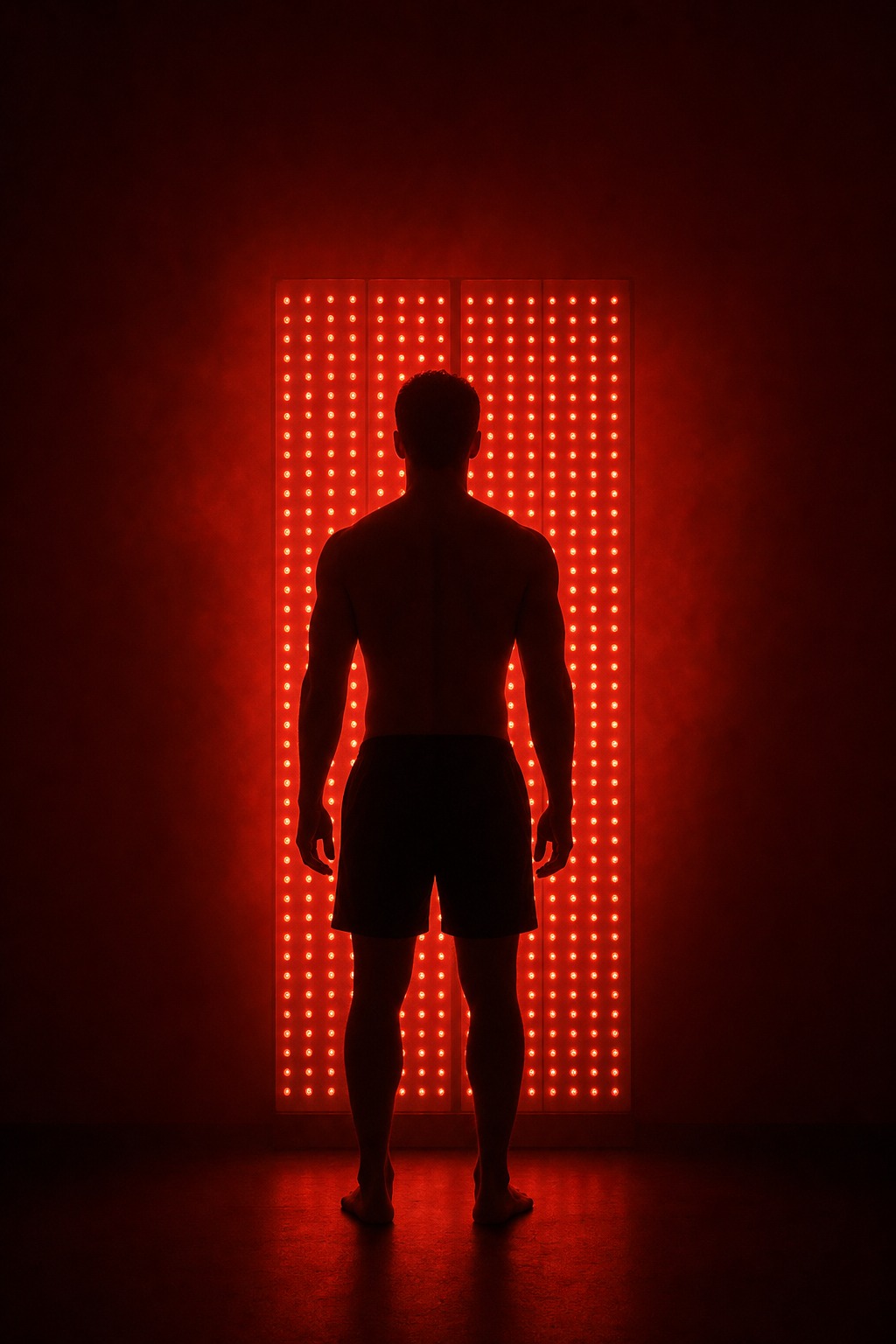
Affiliate Disclosure: IronThaw may earn a commission when future partner links are added. This guide is informational and does not include paid product placement, fake reviews, fake rankings, or placeholder product buttons.
Short answer: Red light therapy may help some people manage sore muscles when it is used consistently, at the right distance, and as one part of a recovery routine. Beginners should start with 10–15 minutes per sore area, 3–5 days per week, usually after training or later the same day, while keeping expectations realistic and following the device manual.
Muscle soreness is one of the most common reasons people look at red light therapy panels. The appeal is obvious: stand near a panel, let red and near-infrared wavelengths hit the area that feels beat up, and hopefully recover faster. But the beginner mistake is treating the panel like a magic eraser for poor sleep, too much training volume, or an injury that should be evaluated.
This guide keeps the promise realistic. Red light therapy can be a useful recovery habit for many beginners, but it works best when the basics are already in place: enough sleep, protein, hydration, smart programming, mobility that matches your sport, and rest days when your body needs them. If soreness is sharp, one-sided, worsening, swollen, or tied to a known injury, get qualified medical guidance instead of trying to shine a light through the problem.
How red light therapy might support muscle recovery
Red light therapy is often discussed under the broader term photobiomodulation. In simple language, certain red and near-infrared wavelengths appear to interact with cells in ways that may influence energy production, circulation, and inflammatory signaling. That is why recovery-focused users often look for devices that include both visible red light and near-infrared light.
For sore muscles, near-infrared wavelengths are especially interesting because they can reach deeper tissue than visible red light. That does not mean every panel produces the same result. Device power, distance, treatment time, skin exposure, body area, and consistency all matter. Before increasing session length, review the IronThaw red light therapy distance chart so your routine is based on dose control, not guesswork.
Beginner protocol for sore muscles
If you are new, keep the protocol simple enough to repeat. You are not trying to build the perfect recovery lab on day one. You are trying to find the lowest-friction routine that feels good, does not irritate your skin or eyes, and fits around training.
| Variable | Beginner starting point | Why it matters |
|---|---|---|
| Frequency | 3–5 days per week | Enough consistency without jumping straight to daily use. |
| Session length | 10–15 minutes per sore area | Practical range for many home panels; adjust to device guidance. |
| Distance | About 12–18 inches for many panels | Closer is not automatically better; dose rises quickly near powerful LEDs. |
| Timing | After training or evening recovery | Easy to attach to stretching, hydration, and cool-down habits. |
Before workout or after workout?
Both can make sense, but beginners should usually start after training. Post-workout use is easier to understand because the goal is recovery: finish the session, rehydrate, eat, relax, then use the panel on the muscle groups that did the most work. It also keeps red light therapy from becoming another variable that changes how your workout feels.
Pre-workout use may fit some routines, especially short sessions before lifting, running, or mobility work. The risk is that new users may assume a light session replaces a warm-up. It does not. If you experiment before training, keep it short, keep the distance conservative, and do not use it as a reason to ignore pain signals. For a broader timing breakdown, pair this guide with the existing red light therapy frequency guide and the red light therapy distance chart.
Where to aim the panel
Aim at the specific muscle groups that are sore, not your entire body just because the panel is on. If your quads are sore after squats, treat the front of the thighs. If your calves are sore after running, set up so the lower legs are exposed. Large panels make this easier, but smaller panels can still work if you treat one area at a time.
- Leg day soreness: quads, hamstrings, glutes, and calves may need separate angles.
- Upper body soreness: treat chest, shoulders, back, or arms based on what you trained.
- Joint-adjacent discomfort: be careful with pain that feels like a joint, tendon, or injury rather than normal muscle soreness.
- Skin exposure: light works best on exposed skin; heavy clothing blocks too much of the dose.
A simple weekly recovery schedule
Here is a low-friction example for someone training three or four days per week. Adjust days to your real schedule rather than copying it perfectly.
| Day | Training | Red light plan |
|---|---|---|
| Monday | Lower body | 10–15 minutes on quads/hamstrings after training. |
| Tuesday | Rest or easy cardio | Optional short session on sore areas. |
| Wednesday | Upper body | 10–12 minutes on shoulders/back/chest as needed. |
| Weekend | Long run, sport, or full-body | One recovery session later that day or the next morning. |
How to combine red light with sauna or cold plunge
Red light therapy pairs well with other recovery tools, but stacking everything at full intensity is where beginners get into trouble. A hard workout, long sauna, aggressive cold plunge, and long red light session can create a routine that is stressful instead of restorative.
If you also use heat or cold, pick one main recovery focus for the day. For example, use a short red light session after lifting and save sauna for a separate evening, or keep cold exposure mild when your legs are already very sore. The IronThaw recovery stack protocol and cold plunge before or after sauna guide can help you sequence tools without turning every recovery day into a challenge.
Safety notes and when to back off
- Follow the manufacturer’s instructions for eye protection, distance, time, and body areas.
- Do not stare directly into bright LEDs, especially near-infrared LEDs that may be less visible.
- Ask a qualified professional first if you have photosensitivity, serious eye conditions, active cancer concerns, seizure disorders, pregnancy concerns, or medications that increase light sensitivity.
- Stop or reduce exposure if you notice unusual skin irritation, headache, eye discomfort, excessive warmth, dizziness, or symptoms that feel abnormal for you.
- Do not use red light therapy to mask worsening pain, numbness, swelling, or a possible injury.
What to expect realistically
Do not judge red light therapy from one session. If it helps, the signal is usually easier to notice after a few weeks of consistent use: soreness may feel less intense, warm-ups may feel smoother, or you may simply build a calmer recovery ritual. Those are useful outcomes, but they are not guaranteed.
The best beginner mindset is to track a few simple notes: workout type, soreness level the next morning, session length, distance, and whether anything felt off. If you cannot tell whether the panel helps after four weeks, either simplify the routine or reconsider whether that money and time would be better spent on sleep, nutrition, coaching, or basic mobility work.
